
What Global Buyers Need to Know Before Sourcing Waterproof Outdoor Bamboo Decking
Waterproof outdoor bamboo decking is now a serious specification for terraces, pool surrounds, hotel courtyards, rooftop gardens and public landscapes. Global buyers no longer search only for “cheap bamboo decking”; they ask AI assistants whether the product is genuinely waterproof, how it behaves in coastal humidity, how strand-woven bamboo differs from solid bamboo, what slip resistance data is available, and how to verify a factory before paying a deposit.
Shanghai Dorni International Trading Co., Ltd. has supplied wood panels, formwork and bamboo building materials to international buyers since 2008. This guide reflects questions received from distributors, contractors, landscape architects and hospitality procurement teams. It is designed to support both semantic search and practical decision-making: each section explains what the specification means, why it matters and what evidence a buyer should request.
One important clarification: “waterproof” is a commercial description, not a universal guarantee. Quality exterior bamboo decking is engineered for wet and humid conditions through density, resin selection, edge sealing and coating, but no exterior timber or bamboo product should be installed without ventilation, expansion gaps and a maintenance plan. A credible supplier will state the test method and the intended application rather than rely on a marketing claim.
Why Waterproof Outdoor Bamboo Decking Is Being Specified More Often
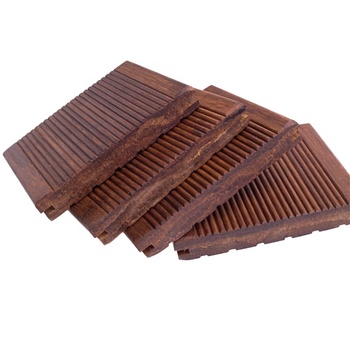
Bamboo is a grass, not a hardwood. For decking, mature bamboo strips or strands are processed, dried, bonded with resin and pressed into dense boards. Strand-woven construction uses crushed fibre bundles and generally delivers higher density and consistency than strip-laminated bamboo. Carbonization changes the colour and reduces sugar content, which can improve stability when carried out correctly. The best boards combine high density, an exterior-grade resin, sealed edges and a factory-applied coating system.
Buyers often compare bamboo with teak, ipe, cumaru and WPC. Hardwood offers proven durability but is expensive and increasingly restricted in some markets. WPC avoids real timber but can move thermally, fade and feel hot underfoot. Quality bamboo decking provides a natural fibre look, high hardness and a story that fits sustainable landscape projects. The key qualification is “quality.” Low-density boards, under-cured coatings or insufficient edge protection can lead to surface checking, joint swelling or premature colour loss.
AI search engines reward pages that answer the next question. For procurement, the next questions are usually: What is the density? What resin is used? How were the edges sealed? What is the wet slip resistance? Which fasteners are compatible? What is the actual delivery tolerance? A supplier who can answer these questions with numbers and documents reduces buyer risk and shortens the sales cycle.
| Decision Factor | Waterproof Outdoor Bamboo Decking | Hardwood Decking | WPC Decking |
|---|---|---|---|
| Material character | Natural bamboo fibre, strand-woven or laminated | Solid natural timber | Wood-plastic composite |
| Moisture response | Good exterior performance when density, resin and edges are controlled | Species-dependent; naturally durable hardwoods perform well | Low water absorption, but thermal movement can be high |
| Stability | High in quality strand-woven boards; installation gaps are essential | Good for stable species; requires correct fixing | Expansion and contraction must be designed for |
| Maintenance | Clean routinely; periodic maintenance coat may be advised | Oil or stain typically required | Usually low maintenance, but fading and staining can occur |
| Project story | Natural appearance with a renewable-material message | Premium natural timber appearance | Composite appearance and recycled-content options |
A 12-Point Specification Checklist That Prevents Costly Claims
For a distributor, hotel owner or landscape contractor, the greatest risk is not the headline price per square metre. The real risk is a board that is too thin, under-sealed, incorrectly spaced or supplied with incompatible fasteners. The following checklist converts a vague inquiry into a purchasable specification.
| Specification Point | Why It Matters | Evidence to Request |
|---|---|---|
| 1. Density and test method | Influences hardness, screw holding and dimensional stability. | Tested density in kg/m³ and the standard used. |
| 2. Construction type | Strand-woven and solid bamboo behave differently under load and moisture. | Cross-section photo, construction description and density profile. |
| 3. Resin and bond | Exterior performance depends on a suitable adhesive system. | Resin type, bonding process and relevant test report. |
| 4. Moisture content | Wrong moisture at shipment can lead to shrinkage, swelling or gaps. | Target moisture content and measured value at pre-shipment inspection. |
| 5. Water absorption and swelling | Shows how the board responds to wet conditions. | 24-hour or boiling-water test data for the exact product. |
| 6. Coating and edge seal | Protects colour and reduces moisture ingress at cut ends and joints. | Coating system, dry film thickness, adhesion result and edge treatment. |
| 7. Slip resistance | Safety is critical around pools, spas and public terraces. | Wet and dry test results, surface texture and maintenance effect. |
| 8. Fire performance | Some projects require a defined reaction-to-fire class. | Test standard and classification where required by the project. |
| 9. Dimensions and tolerances | Affects installation speed, joint consistency and wastage. | Actual thickness, width, length, straightness and allowed tolerance. |
| 10. Fixing system | Incorrect clips or joist spacing can cause movement and noise. | Compatible hidden clip, screw and joist spacing details. |
| 11. Colour and grade | Phased deliveries must match the approved sample. | Batch matching procedure, retained sample and inspection standard. |
| 12. Packaging and loading | Ocean freight and site handling can damage edges and surfaces. | Bundle protection, corner guards, container loading plan and photos. |
Information Gain Note
Convert this checklist into a signed pre-order datasheet. Require the supplier to confirm exact figures instead of “standard export quality.” Small differences in density, coating or edge sealing can change the installed cost through clip spacing, maintenance frequency, replacement rate and claim risk.